





- Surrogacy in Mexico for Americans
- Mexico vs. the United States: Understanding the Differences
- Why more American intended parents are considering Mexico
- How much does surrogacy cost in the United States?
- How much does surrogacy in Mexico cost for Americans?
- Is surrogacy legal in Mexico for American intended parents?
- How does the legal process differ in the United States?
- Will the baby be a U.S. citizen if born in Mexico?
- How long must American parents remain in Mexico after the birth?
- Mexico vs. U.S. surrogacy: which option is right for you?

Surrogacy in Mexico for Americans is attracting growing interest.
We have already looked at how surrogacy in Mexico works for American intended parents. Now, more Americans view it as an alternative to pursuing a journey in the United States. We continue to receive questions about costs, legal parentage, medical care, U.S. citizenship and returning home with the baby: this guide brings those answers together.
The reasons behind this trend are easy to understand. Although the United States remains one of the world’s most established surrogacy destinations, particularly in surrogacy-friendly states, costs have risen considerably, matching can take longer than expected and insurance exclusions can make the final budget difficult to predict.
However, Mexico vs. U.S. surrogacy is not simply a comparison of prices.
Mexico is close to the United States, programs generally cost considerably less and American intended parents can remain within the same time zones while coordinating their journey. However, international surrogacy also involves legal, citizenship and travel considerations that don’t arise in the same way during a domestic U.S. journey.
The purpose of this comparison is not to declare one country better for everyone, but to help you understand which option is more appropriate for your family, budget and priorities.
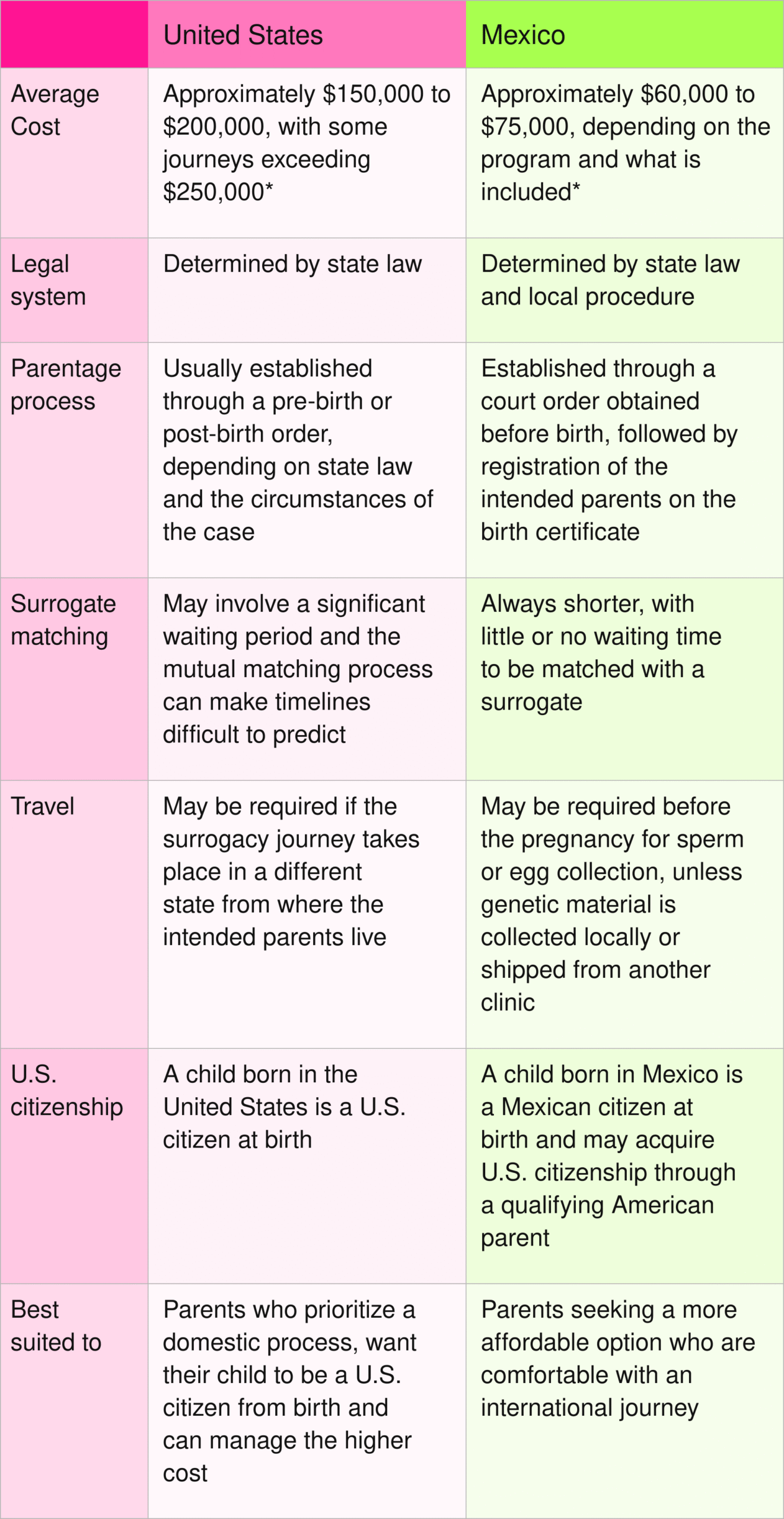

*These are general estimates rather than fixed prices, so the final cost may be higher than the amount initially advertised
Cost is the most obvious reason, but it’s not the only one.
Many of the American parents who contact us already have embryos stored at a fertility clinic in the United States. Some have spent years undergoing IVF, while others have investigated domestic surrogacy and discovered that the total budget is beyond what they can reasonably afford.
They are usually looking for three things: a more manageable cost, a shorter path to matching and a program that does not reduce legal or medical safeguards just because it takes place outside the United States.
Mexico’s geographic proximity also matters. Direct flights are available from many U.S. cities, there is little or no time difference for much of the country and intended parents can often travel more easily than they could to a destination in Europe or Asia. Nevertheless, proximity should be treated as a practical advantage, not as a substitute for legal planning.
In many cases, yes.
Intended parents who already have frozen embryos in the United States (or in another country) may be able to ship them to a Mexican fertility clinic using a specialized cryogenic courier.
Before arranging the shipment, the receiving clinic should review the embryo-development and freezing reports, infectious-disease screening records, PGT-A reports when applicable, consent forms, chain-of-custody documents, and information about the storage device and laboratory protocol used. The clinic must also confirm the applicable import, export and courier requirements.
Not every clinic accepts embryos from every laboratory, and documentation standards can differ. The Mexican clinic should therefore confirm acceptance before the intended parents sign a program or authorize transportation.
Embryo shipping is particularly relevant when comparing Mexico vs. U.S. surrogacy because it allows intended parents to use embryos already created in the United States without repeating the entire IVF process. However, the shipping cost, the receiving clinic’s requirements and the condition of the embryos must be assessed individually.
A U.S. surrogacy journey often costs between $100,000 and $200,000. In more expensive states or when multiple embryo transfers, the surrogate’s health insurance, pregnancy complications or neonatal care are involved, the total can exceed $250,000.
The final cost is made up of many different expenses. These usually include agency and case management fees, surrogate compensation and allowances, IVF treatment, medication, embryo transfers, medical and psychological screening and egg donation when needed. Intended parents must also budget for separate legal representation for themselves and the surrogate, health and life insurance, prenatal care, delivery, hospital fees and the legal proceedings required to establish parentage.
Other expenses may include the surrogate’s lost wages, childcare and travel, as well as unexpected medical treatment or NICU care. The United States is expensive also because every professional, legal and medical service is priced within the U.S. system. Surrogate compensation is also generally higher and even a health insurance policy that covers pregnancy may specifically exclude surrogacy.
This doesn’t mean that surrogacy in the United States is an unreasonable choice. It simply means that intended parents need a realistic budget from the beginning, together with enough additional funds to cover unexpected costs.

Surrogacy programs in Mexico generally cost the same for intended parents, regardless of whether they are American or from another country. Program prices commonly range from approximately $60,000 and $100,000. The amount can be higher depending on whether the parents need an egg donor, IVF and embryo creation, PGT-A testing, embryo transportation, multiple transfers or a guaranteed program.
The important comparison is not the starting price but what the program actually includes.
Before comparing options, intended parents should confirm whether the cost covers surrogate recruitment and screening, IVF and the number of embryo transfers, egg donation and medication when needed, prenatal appointments, routine testing, surrogate compensation and expenses and health and life insurance.
The quotation should also explain whether legal representation, court proceedings, birth registration, delivery and hospital expenses and assistance with the U.S. consular process are included. It’s also important to understand what happens if the first surrogate cannot continue, a transfer fails, a miscarriage occurs or the baby is born prematurely and requires NICU care.
A $60,000 program may end up costing more than one priced at $75,000 for this reason, we believe that knowing how much the whole journey is likely to cost is more valuable than choosing a program simply because it has the lowest starting price.
There is no single federal surrogacy law that creates one identical procedure throughout Mexico. Surrogacy legislation and civil registration rules vary by state, and some states have specific restrictions.
This doesn’t mean that no legal route exists for foreign intended parents. Mexican Supreme Court decisions have recognized important principles related to reproductive autonomy, equality, family diversity, legal parentage and a child’s right to identity. The Court has also considered cases involving same-sex intended parents and children born through surrogacy.
However, a constitutional principle is not the same as an automatic administrative procedure. The legal route must be assessed before medical procedure begins and adapted to the intended parents’ family structure, marital status, genetic plan and chosen place of birth.
The surrogacy agreement is important, but the contract alone should never be presented as sufficient protection.
For surrogacy in Mexico for Americans, the Mexican process and the U.S. return-home process must be designed together. Solving parentage in one country without checking its effect in the other can create avoidable delays.

Surrogacy law in the United States is also state-specific. Some states have detailed statutes that expressly permit compensated gestational surrogacy and establish requirements for contracts, screening and parentage. Others offer a workable route through case law, while a smaller number remain restrictive or less predictable.
In favorable jurisdictions, intended parents may obtain a pre-birth order, a post-birth order or another judicial determination directing how the birth certificate should be issued. The procedure depends on the state, the parties’ circumstances and, sometimes, their genetic relationship to the child.
The main advantage is that the child is born in the United States and is a U.S. citizen from birth. The parents doesn’t need to complete an overseas process before returning home.
The disadvantage is cost. Choosing a favorable state may also require travel, additional legal representation, insurance planning and extended accommodation away from home.
Whether their baby will be a U.S. citizen is probably the most important question American intended parents ask us.
A baby born in Mexico doesn’t receive U.S. citizenship just because the intended parents are American. Citizenship must be determined under the rules that apply to children born abroad.
According to the U.S. Department of State, a child born through surrogacy may acquire citizenship through a qualifying U.S. citizen parent who has a genetic or gestational connection to the child. Current policy also recognizes certain cases involving a non-genetic and non-gestational U.S. citizen parent who is married at the time of birth to a parent with the required connection, provided that all other legal requirements are met.
The U.S. citizen parent must also meet the applicable physical presence or residence requirements. These vary according to the parents’ citizenship, marital status and the provision of law that applies.
After the birth, the intended parents will normally apply for a Consular Report of Birth Abroad and the baby’s first U.S. passport. They must also provide any supporting citizenship and parentage documents requested by the consular officer.
The consulate may ask for evidence concerning conception and birth, legal parentage, the U.S. parent’s citizenship and their previous physical presence in the United States.

There is no single waiting period that applies to every family. The length of the stay depends on the baby’s health, how long it takes to obtain the Mexican birth certificate and complete the court process, and when a consular appointment is available. Consular appointment availability and the time required to issue the U.S. passport or other travel documents can also affect the timeline.
The parents’ documents must be complete and consistent. Even a minor discrepancy can cause delays, particularly when several authorities are responsible for different parts of the process.
Intended parents shouldn’t assume that they’ll be able to fly home a few days after delivery. Even a straightforward case takes time, while a premature birth, document discrepancy or legal complication can extend the stay considerably.
Before starting the journey, intended parents should receive an estimate based on their individual circumstances and be prepared to remain in Mexico longer if necessary. However, one parent can return to the United States earlier while the other remains in Mexico with the baby if necessary.
The United States offers a highly developed domestic surrogacy system, especially in states with clear laws and experienced courts. For intended parents who can accommodate the cost, it may provide greater familiarity and a simpler citizenship process.
Mexico offers a more affordable and geographically convenient alternative for many American families. It also provide shorter matching times and flexible program options. However, the process involves two legal systems, so parentage, birth registration, citizenship and travel must be carefully planned.
In our opinion, the right question is not simply, “Which country is better?” It’s, “Which option gives our family the certainty we need?”
At The Baby Surrogacy, we help intended parents compare programs, understand what each one includes and coordinate the legal, medical and practical stages of international surrogacy.
If you are an American intended parent considering surrogacy in Mexico, contact us for a personalized assessment based on your family structure, embryos, budget and return-home requirements.


