





Uterus transplant offers another possible path to parenthood for women born without a uterus or those who have lost it because of illness or surgery.
For many years, the main alternatives were adoption or surrogacy. Today, uterus transplantation has introduced another possibility. A small but growing number of women have received a donated uterus, become pregnant through IVF and given birth.
It’s an extraordinary medical development. It’s also a long, demanding and still uncommon procedure that cannot be reduced to the transplant surgery alone.
As interest in uterus transplant and surrogacy grows, it’s important to understand what these two paths involve, who they may be suitable for and why one cannot simply be described as a replacement for the other.
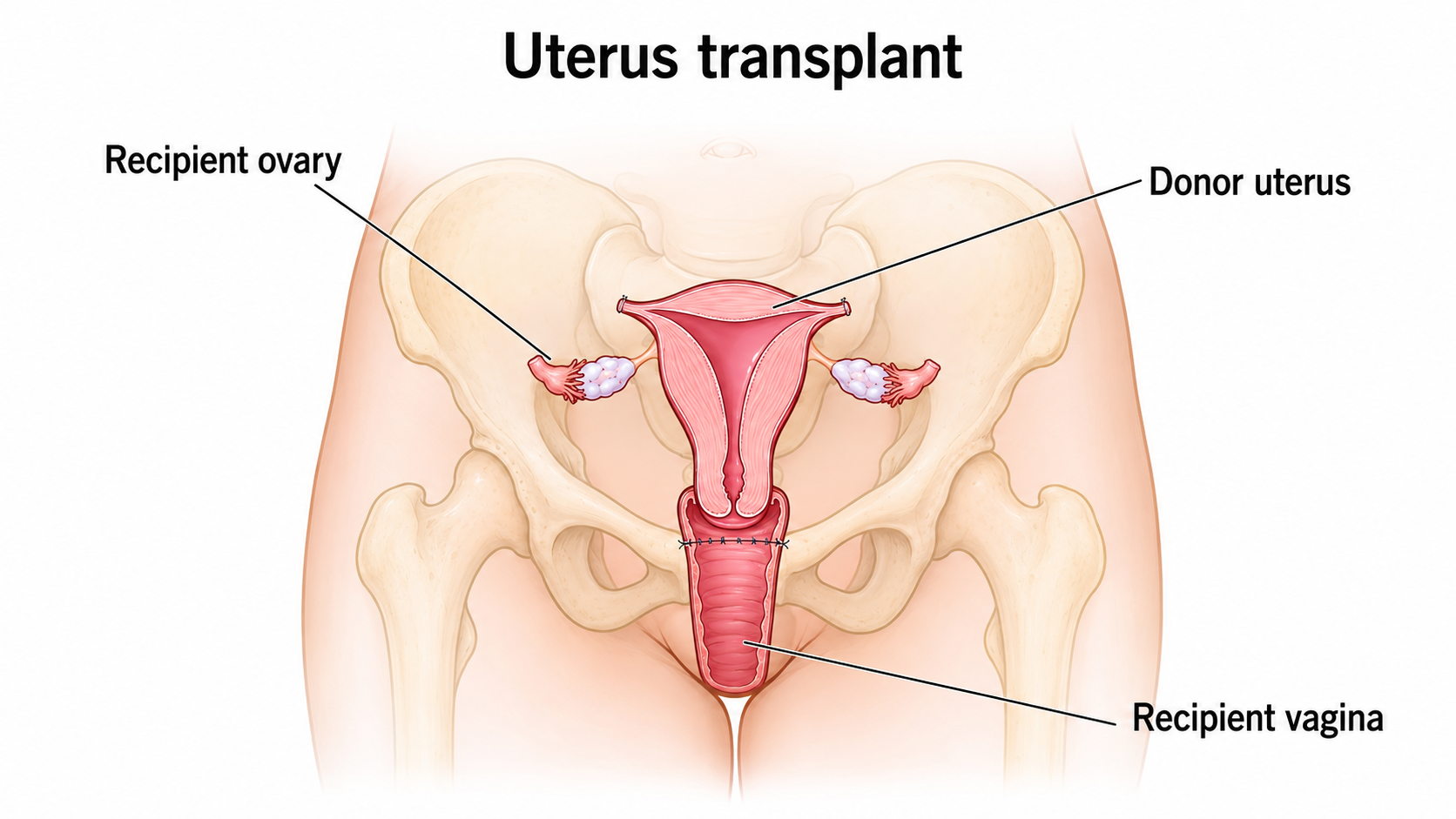
Uterus transplantation, also known as a womb transplant, is a procedure in which a healthy uterus is removed from a living or deceased donor and transplanted into a woman who does not have a functioning uterus.
This condition is known as absolute uterine factor infertility. It may affect women born without a uterus, including some women with Mayer-Rokitansky-Küster-Hauser syndrome, as well as those who have undergone a hysterectomy or whose uterus cannot sustain a pregnancy.
Unlike a heart or kidney transplant, a uterus transplant is intended to be temporary. Its purpose is to allow the recipient to attempt one or, in some programs, two pregnancies. Once she has completed her family, the transplanted uterus is normally removed so that she can stop taking anti-rejection medication.
The first live birth following a uterus transplant took place in Sweden in 2014.
Interest in the procedure grew again in 2025, when the first baby in the United Kingdom was born following a womb transplant.
Grace Davidson was born without a functioning uterus and received one donated by her sister in 2023. Before the surgery, Grace and her husband created embryos through IVF. One of those embryos was later transferred to the transplanted uterus, and their daughter was born by planned cesarean section in February 2025.
The birth was a major moment for British reproductive medicine. It also showed the scale of the process behind the headlines. The journey required a donor, complex surgery for both sisters, IVF, anti-rejection medication, close medical monitoring and a cesarean birth.
This was not simply another form of fertility treatment. It was organ transplantation followed by assisted reproduction and a high-risk pregnancy.
A transplanted uterus is not connected to the recipient’s fallopian tubes. Natural conception is therefore not possible after the procedure.
Embryos must be created through IVF, usually before the transplant takes place. If the surgery is successful and the uterus remains healthy, doctors may consider an embryo transfer after a recovery period.
The recipient must continue taking immunosuppressive medication to prevent her body from rejecting the organ. She is monitored throughout the pregnancy by a specialist team, and the baby is delivered by cesarean section.
There are several points at which the process may not progress as hoped. A candidate may not qualify for a transplant. A suitable donor may not be available. The transplanted uterus may fail, an embryo may not implan, or a pregnancy may end in miscarriage. A uterus transplant can make pregnancy possible, but it cannot guarantee the birth of a child.
Eligibility depends on the country and the specific research or clinical program available.
In general, candidates must be of reproductive age, in good overall health and able to undergo major surgery, IVF, pregnancy and cesarean delivery.
They must also be able to take anti-rejection medication and usually need to have embryos available before proceeding. Programs may impose age, weight and health restrictions, and they carry out extensive physical and psychological assessments.
This makes uterus transplantation an option for a very specific group of women. It is not currently an option for every person who needs the help of a gestational surrogate.
Single men and male couples cannot use uterus transplantation as a route to parenthood. It may also be unsuitable for women whose medical condition makes pregnancy dangerous, even if transplantation itself were technically possible.
The desire to experience pregnancy is completely understandable. However, anyone considering a uterus transplant needs a clear picture of the medical burden involved.
The recipient faces the usual risks of major transplant surgery, including bleeding, infection, blood clots, injury to nearby organs and rejection of the donated uterus. Anti-rejection drugs can also cause side effects and require continued monitoring.
If the uterus comes from a living donor, that person must undergo a complex hysterectomy that offers her no medical benefit. She accepts the risks of surgery solely to give another woman the possibility of carrying a pregnancy.
Pregnancy following transplantation is treated as high risk. After childbirth, the recipient may then face another operation to remove the uterus. As Johns Hopkins Medicine explains, the process involves risks for the donor, the recipient and the subsequent pregnancy.
None of this diminishes the importance of uterus transplantation. It simply places the achievement in its proper medical context.

Uterus transplant and surrogacy may be discussed together because both can help someone have a child when carrying a pregnancy is otherwise impossible. But medically and legally, they follow very different paths.
With a uterus transplant, the intended mother undergoes the transplant, receives an embryo and carries the pregnancy herself. With gestational surrogacy, an embryo is transferred to a gestational surrogate, who carries the baby for the intended parent or parents without having a genetic connection to the child.
In both cases, IVF is generally required. Beyond that point, the two processes are quite different.
A uterus transplant places the physical burden of transplantation, pregnancy and childbirth on the intended mother, as well as surgical risk on a living donor when one is used. Surrogacy places the physical demands of pregnancy on the gestational surrogate and requires a legal structure that clearly defines consent, responsibilities, expenses and parentage.
Neither path should be presented as easy. The relevant question is which option is medically possible, legally available and personally acceptable in a particular case.
No. Uterus transplantation expands reproductive choice, but it does not make surrogacy unnecessary.
Surrogacy remains an important option for people who cannot carry a pregnancy and are not eligible for transplantation. This includes male couples, single men, women of advanced reproductive age and women for whom pregnancy would create an unacceptable medical risk.
Availability is another major difference. Gestational surrogacy is legally accessible in a number of countries, although the rules, costs and parentage procedures vary considerably. Uterus transplantation is available only through a limited number of highly specialized centers, often under strict selection criteria or research protocols.
There is also a personal distinction. Some women place great importance on experiencing pregnancy themselves and may be willing to consider the risks of transplantation. Others may decide that undergoing multiple surgeries and taking immunosuppressive medication is not the right choice for them.
Choosing surrogacy does not make someone less of a mother. Carrying a pregnancy is one part of reproduction, not the definition of parenthood.
The discussion around uterus transplant and surrogacy is sometimes framed as if society must choose between them. That is the wrong comparison.
Uterus transplantation gives a small number of women the possibility of carrying a pregnancy that would otherwise be impossible. Surrogacy allows a broader group of people to build a family when pregnancy is not possible or would not be safe.
One is not more genuine than the other. One does not cancel out the need for the other.
The real value of medical progress is that it can create more choices. Those choices should be explained honestly, with neither unrealistic promises nor moral judgment.
After a uterus transplant, the woman giving birth is normally also the intended and legal mother. The main questions are medical and clinical rather than the transfer or recognition of parentage.
Surrogacy requires more legal planning. The law must determine who the child’s parents are, how the gestational surrogate’s consent is recorded, whose names appear on the birth certificate and what must happen before the family can return home.
These rules are not the same everywhere. In some jurisdictions, the intended parents can be recognized through a court order and named on the final birth certificate. In others, further proceedings are required after birth.
For international intended parents, the law of the country of birth must also be considered together with the rules on citizenship, passports and recognition of parentage in their home country.
This is why the destination should never be chosen on price alone.
The answer depends on much more than personal preference.
A woman interested in uterus transplantation needs an assessment from a specialist transplant and reproductive medicine team. She must understand the eligibility requirements, the possible wait for a donor, the risks of surgery, the need for IVF and the uncertainty of reaching a live birth.
Anyone considering surrogacy needs a different type of assessment. Medical feasibility remains important, but so do the laws of the destination country, eligibility, legal parentage, the birth certificate and the process for returning home with the baby.
Before deciding, intended parents should compare the complete journey, not only the possibility of pregnancy itself.
Uterus transplantation is one of the most remarkable developments in modern reproductive medicine. For some women born without a uterus or who lost it at a young age, it may offer something that was previously impossible: the opportunity to carry and give birth to their own child.
At the same time, it remains a complex and limited option involving organ donation, major surgery, IVF, immunosuppressive medication, a high-risk pregnancy, cesarean delivery and, eventually, removal of the transplanted uterus.
Surrogacy continues to offer a different path for people who cannot carry a pregnancy, do not qualify for a uterus transplant or decide that transplantation is not right for them.
The choice should not be driven by headlines or by the idea that one path is somehow more valid. It should be based on honest medical advice, a clear understanding of the law and the circumstances of the person or family hoping to welcome a child.


