




Surrogacy in Europe in 2026
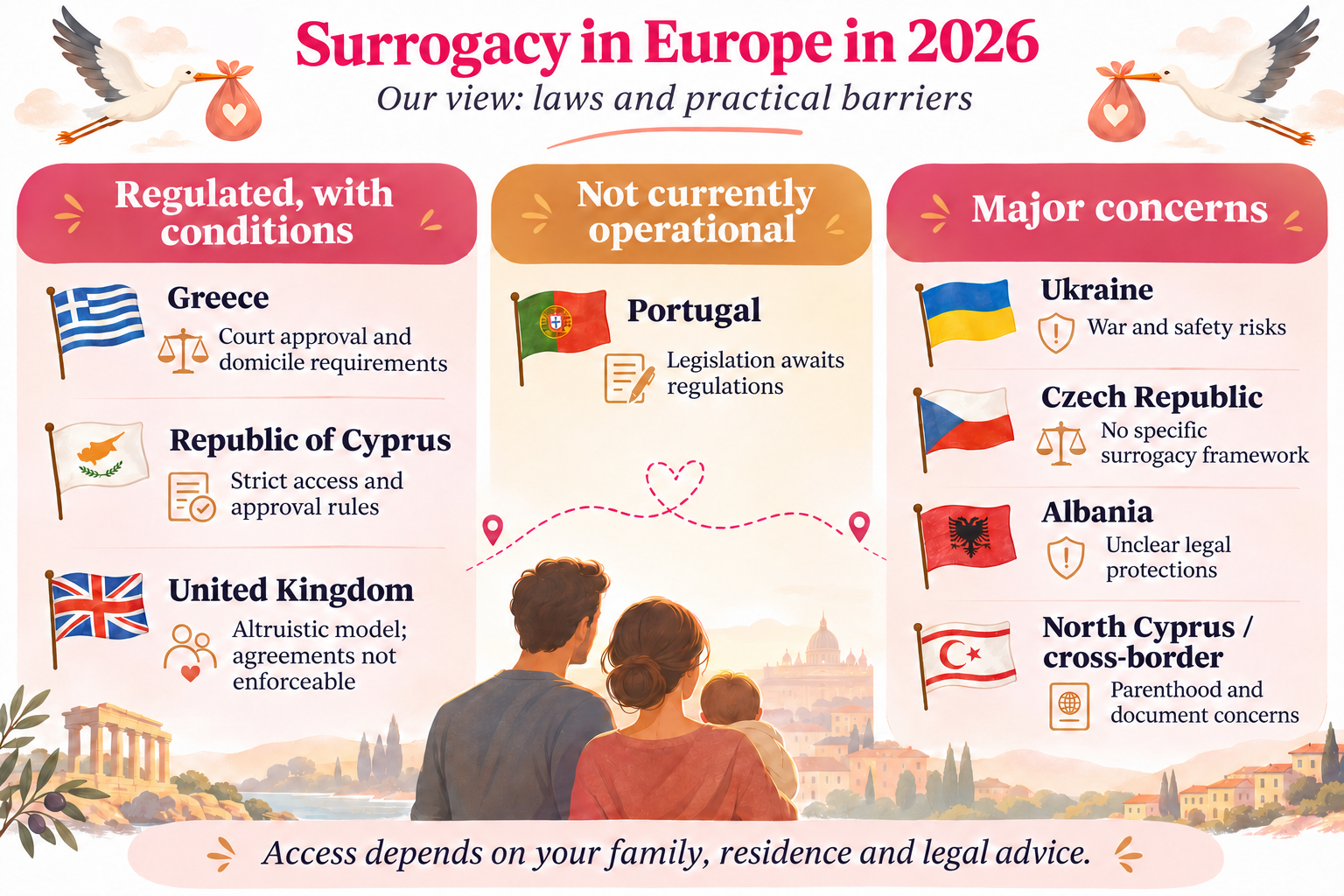
Surrogacy in Europe can seem like the most practical choice if you live nearby and want to stay close to home. But once you start looking at individual countries, the picture becomes more complicated. Some have clear laws with strict conditions. Others are advertised as destinations even though important legal questions remain unresolved. In the last two years, many things have changed.
Our view comes from looking at both the law and what intended parents actually experience. A process may be permitted, but that does not necessarily make it easy to complete.
Greece
Greece allows gestational surrogacy for women (or couples) who cannot carry a pregnancy for medical reasons, with court approval required before embryo transfer.
The rules changed in May 2025. Both the intended mother and the surrogate must now have their domicile in Greece. Traveling there for treatment does not, by itself, meet this requirement. The legal route is not available to single men or male couples.
In our experience during 2026, there has also been some uncertainty around court proceedings, particularly for single women. This has sometimes made it difficult to give parents a clear idea of how their application would progress. For anyone considering Greece, the court process deserves as much attention as the medical treatment.
Pros: Greece has a specific legal framework for surrogacy and is part of the Schengen Area, making travel easier for intended parents living in other Schengen countries.
Cons: The overall process can be lengthy, and the surrogate must meet strict eligibility requirements, including having her domicile in Greece.
Cyprus
When discussing surrogacy in Europe, Cyprus needs a careful explanation. There are programs advertised in South Cyprus, programs in North Cyprus, and cross-border arrangements involving both.
South Cyprus, the Republic of Cyprus, has a regulated altruistic model with medical requirements, residence conditions, and approval procedures. However, access can be difficult, particularly for international intended parents.
The rules are different in North Cyprus. As we explain in our article on Cyprus, we have serious concerns about programs offered without a clear legal process for establishing parenthood and obtaining the baby’s documents.
Some intermediaries also advertise cross-border programs, with treatment in the North and birth or legal procedures planned in the South. Parents should never assume that carrying out part of the process in the Republic of Cyprus automatically resolves the legal questions arising from an arrangement elsewhere.
Pros: The Republic of Cyprus has a specific legal framework for altruistic surrogacy, with approval procedures before treatment begins.
Cons: Strict eligibility and residence requirements can make access difficult for international intended parents. Programs in North Cyprus and cross-border arrangements raise additional concerns about parenthood and the baby’s documents.
Ukraine
Ukraine was once one of the most popular surrogacy destinations for intended parents from around the world. Surrogacy is available to married heterosexual couples where the intended mother cannot carry a pregnancy for medical reasons. At least one parent must be genetically related to the baby, meaning the couple must use their own eggs, sperm, or both. The Ukrainian birth certificate names the intended parents.
Today, the war has changed how we assess this option. We do not currently recommend Ukraine as a surrogacy destination. Frequent attacks, damage to infrastructure, and travel difficulties raise serious concerns for the surrogate, the baby, and the intended parents.
Pros: A well-established legal framework that allows the intended parents to be named on the baby’s birth certificate.
Cons: The war creates serious safety and travel concerns. Depending on the intended parents’ nationality, obtaining the baby’s citizenship and travel documents through their consulate may also be complicated and take longer than expected.
Portugal
Many intended parents from Portugal who contact us are surprised to learn that their country has passed legislation allowing surrogacy in certain medical circumstances. When they discover this through our website, they ask how they can begin.
The difficulty is that allowing surrogacy by law and making it available in practice are two different things. Portugal’s reproductive medicine authority, CNPMA, states that the legislation still awaits government regulations. For now, we cannot describe Portugal as a destination where parents can start a surrogacy program.
For anyone considering surrogacy in Europe, Portugal shows why it is important to look beyond whether a country has passed a law and understand whether the process can actually go ahead.
Pros: Legislation has been passed allowing altruistic surrogacy in specific medical circumstances.
Cons: The regulations needed to put that legislation into practice are still pending, so parents cannot currently rely on it to begin a program.
Czech Republic
The Czech Republic does not specifically regulate surrogacy. The woman who gives birth is the legal mother, and a surrogacy agreement cannot force her to hand over the baby. Establishing the intended parents’ legal status involves the applicable parentage and adoption rules. Payments connected to handing over a child can also carry criminal consequences.
Before accepting a program, parents should understand whose consent is needed after birth and what happens if that consent is withdrawn.
Pros: There are no clear advantages, although it may be an option worth examining for single men and people who already live in the Czech Republic, depending on their circumstances.
Cons: There is no specific legal framework for surrogacy, and agreements are not enforceable. The surrogate is the legal mother at birth, so establishing the intended parents’ legal status requires further steps under parentage and adoption rules.
Albania
Albania also appears in discussions about surrogacy in Europe, but the available legal research describes a practice without a complete regulatory framework. Proposals to change reproductive health law should not be presented as though they already provide an established legal process.
If you are considering Albania, ask for a written legal explanation covering the birth certificate, parental rights, the surrogate’s position, and your baby’s travel documents. An offer from a provider should be supported by answers you can verify.
Pros: It may be an option for intended parents who already live in Albania, subject to legal advice.
Cons: The lack of a complete legal framework raises concerns about the surrogate’s rights, recognition of the intended parents, birth registration, and obtaining the baby’s travel documents.
United Kingdom
The United Kingdom remains one of the most talked about destinations for surrogacy in Europe in 2026.. Yet being legally permitted does not make it easy to arrange.
The domestic system is based on altruistic surrogacy, with reasonable pregnancy related expenses allowed. Intended parents sometimes struggle to understand what this means in practice. Finding a woman willing to carry a pregnancy for someone she doesn’t know can take time, even years.
Surrogacy agreements are not legally enforceable, and the surrogate is the legal mother at birth. Intended parents need a parental order to transfer legal parenthood, which requires the surrogate’s consent.
The UK also permits traditional surrogacy, where the surrogate’s own egg is used, meaning she is genetically related to the baby. This differs from gestational surrogacy, where she has no genetic connection.
In our view, traditional surrogacy deserves particular care because of the emotional questions it can raise alongside an agreement that cannot be enforced. We have dealt with a case in which the surrogate changed her mind. That experience has shaped how we explain these risks to intended parents. The legal uncertainty around consent must be understood in either type of surrogacy.
Pros: An established legal system, with a parental order process for transferring parenthood to eligible intended parents.
Cons: Finding a surrogate can take a long time, and the overall cost can be higher than in other destinations. Agreements are not enforceable, and legal parenthood is transferred after birth, with the surrogate’s consent.
Our view on Surrogacy in Europe in 2026
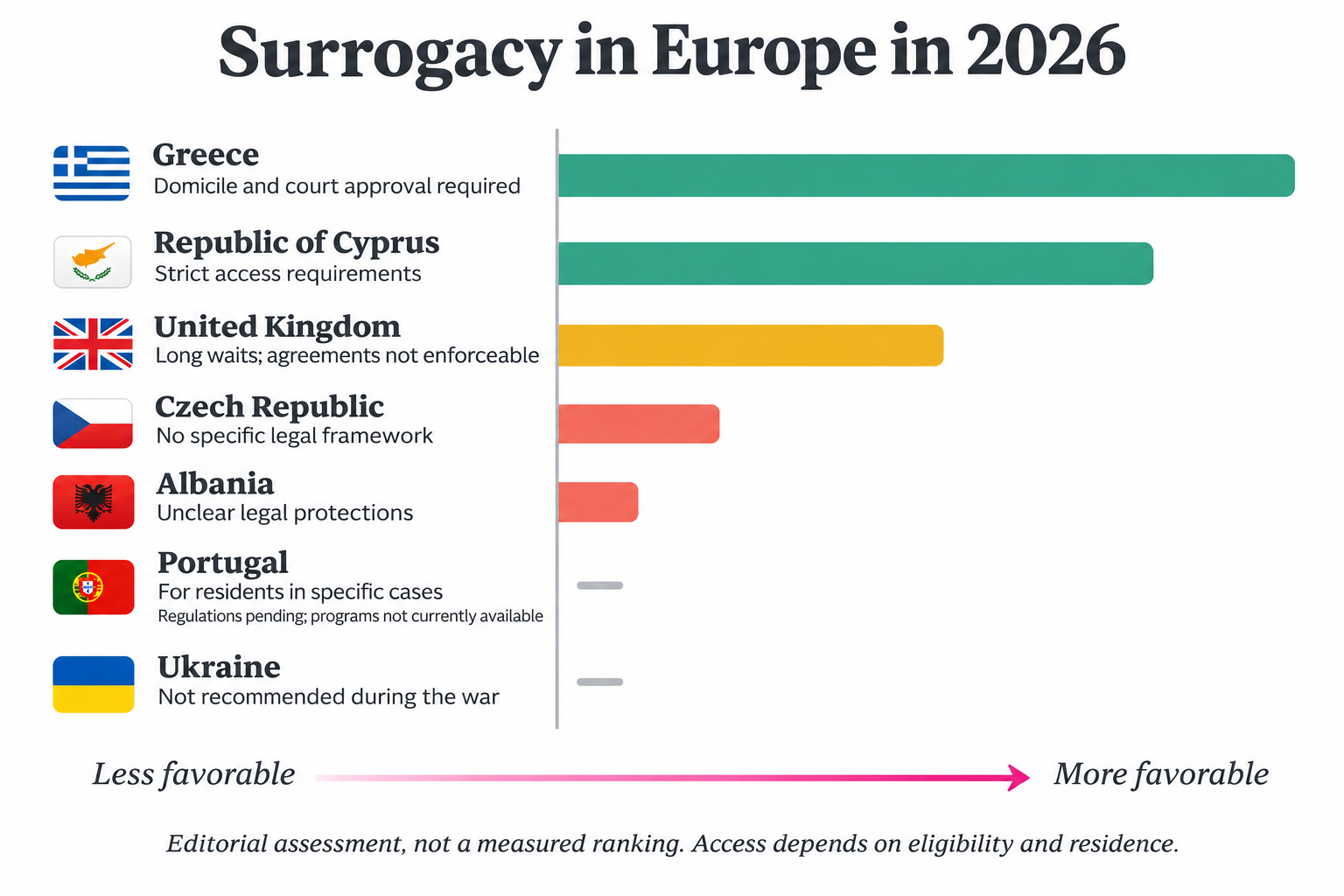
Surrogacy in Europe cannot be assessed simply by asking where it is permitted. Parents need to know whether they qualify, how the process works and how their family will be legally recognized after birth.
Being close to home is valuable.
Knowing you will be recognized as parents and can return home with your baby is priceless.